Resources

I’ve written articles for health and safety publications since 1996, first for Health and Safety at Work Magazine, and later for IOSH Magazine, including the Lexicon series. I’ve also presented on a range of topics at professional conferences. Have a look at examples of articles, presentations and webinars.
I am available for presentations, panels, debates and webinars on a wide variety of safety topics. In the past I have “ghost written” white papers, blogs and press releases on safety and health topics, particularly those linked to technology.
I stopped writing blogs for product marketing when I realised I was writing for search engines, not people. However, if you have a writing project in mind where you need a real person to write for real people, please get in touch. You can also let me know if there’s an article listed which I haven’t yet linked that you’d like to read.
I have been comfortable standing in front of an audience since I was 11, as my wonderful English teacher encouraged us by holding in-school debates and putting us up for between-school speaking competitions. I’m equally happy providing an interactive training or coaching workshop, delivering a session for an IOSH or other professional meeting (in person, or virtual), participating in a webinar or podcast, or giving a formal presentation to a large audience.
Take a look at some presentation topics that are “oven-ready”, or let me know if there’s something bespoke you’re interested in.
You might find it useful to listen to some of my Webinars.
For more background, I’ve listed older peer-reviewed publications.
Articles
Learning and training
- When virtual training isn’t enough. A description of a day’s ladder user and inspection training, demonstrating when only a hands on approach will work.
- Manual handling training: the evidence for, and against. Is there any evidence that manual handling training is worth the time and money, and how can it be improved?
- How extended realities could transform workplace safety training. An article for RoSPA looking at examples of AR and VR in safety training.
- Back on course. How training providers have adapted essential health and safety training to cope with social distancing (written with Louis Wustemann)
- The Right Fit. How different learning tools can be blended to create a great learning experience, from traditional classroom, to new experiences with virtual reality
- Learning and forgetting. The problem of skill decay, and suggestions of how to overcome it.
- Learning in style. The myths and dangers of learning style theories.
- A PowerPoint well made. Some tips on how to make better use of PowerPoint as a health and safety training aid.
- Letters of distinction. Rote learning is not the ultimate goal of health and safety education. Understanding, attitude and application are critical, and these require a lot more effort than a few mnemonics. But there are times when an aide-memoire can prompt a sequence that helps us to focus a risk assessment or audit – or even to pass an exam!
- How to learn? A comparison of the pros and cons of classroom, on-the-job and eLearning. Originally written for EssentialSkillz, but now on the Vinci website (uncredited).
- Skill Decay: How To Keep Employee Training Fresh. Considering the problem of skill decay, and refresher training. Originally written for Engage EHS, now on EcoOnline website (uncredited).
I was a panelist on this webinar in 2022 which discussed the need to rethink workforce safety and health learning and training. Register to watch the recording.
An older article in HSW magazine asked for my thoughts on using drama in training.
Human Factors & Ergonomics
Many of my articles have a Human Factors aspect to them, but I’m working to link all the ones with a more specific focus on human factors and ergonomics into this section.
- Is more training the best solution for risk prevention? (the answer is no!). When doing a risk assessment, more training is sometimes suggested as an additional control to avoid accidents. But is more training really the answer? This article reviews the practical application of Human Reliability Assessment (HRA) techniques in occupational health and safety. It includes details of HEART (Human Error Assessment and Reduction Technique) devised by Jerry Williams. Jerry contributed to the article, as did former HSE / HSL human factors specialist, Julie Bell.
- Safety in Design is covered in an IOSH article called ‘How to prevent MSDs early‘ It includes contributions from the COO at the Chartered Institute of Ergonomics and Human Factors (CIEHF) and from the senior policy adviser on musculoskeletal disorders (MSDs) at the HSE.
- What do we really mean when we say ‘behavioural safety’? You can’t motivate people to be taller, stronger, faster or fitter than they are. An article for RoSPA where I critique the way people say ‘behavioural safety’ when they mean motivating people to follow their arbitrary or contradictory rules.
- Sit-stand desks: are they worth the extra cost?
- Manual handling training: why manual handling training might not be the most effective way to reduce manual handling injuries (but changing the physical and psychosocial environment might be).
- Pain factory: it’s more than physical ergonomics looks at why we need to look beyond purely mechanical explanations for pain in musculoskeletal disorders.
- Behavioural economists know that you get more from people by nudging than nagging. The EAST framework provides some useful pointers for non specialists.
- Health psychologists (IOSH Magazine) This article outlines how the Behaviour Change Wheel and COM-B principles can identify human factors that need to be changed.
- Cognitive psychologists (IOSH Magazine) can warn us of the mistakes how minds can trick us into during accident and incident investigation, and how to overcome unconscious bias.
- Taken to task (IOSH Magazine) explains how task analysis should be as much of a tool for OSH professionals as is risk assessment.
Psychology, wellbeing and mental health
In a series of articles for IOSH Magazine covering research on health and safety topics, I’ve included reports relating to wellbeing and mental health, including:
- Taking care of key workers, learning from an ILO report on the value of essential work.
- Should senior leaders disclose their mental health stuggles? A critical review of the (lack of) evidence from the InsideOut LeaderBoard
- Psychological injury most common workplace harm reviewing an ILO survey on Experiences of violence and harassment at work
- Economic change impacts workforce health and safety summarising some findings from the ILO World Employment and Social Outlook: Trends 2023 report
Please note that the IOSH Magazine links to the original reports often don’t work, so use my links above, or just Google the name of the report.
Some articles and blogs don’t have my name on them, but if you read enough of my articles, you’ll recognise a style!
- 4 ways your mind tricks you in an incident investigation. This applies my psychology background to the problem of incident investigation.
- Using social safety to drive behaviour change. A look at how the EAST framework links to the Engage EHS concept of ‘social safety’.
Psychology comes into a lot of my other articles, but I’ve linked a few items here that don’t fit well into the other categories.
- Supporting suicide prevention in the workplace. This is a blog I wrote on LinkedIn, as my response to a powerful event I attended (online) in 2021.
- Suicide myths and evidence-based rebuttals. This was a second LinkedIn blog prompted by material from the 2021 Suicide Prevention Summit.
- Cognitive psychology – how unconscious bias affects our decisions, especially during an accident investigation.
- Behavioural economics – how to influence workplace behaviours using nudging (rather than nagging).
- Health psychology – how motivation, opportunity and capability affect behaviours.
- Magicians – what magicians know about psychology, and how that can help us understand
Augmented and Virtual Reality, AI, Robots and other high tech
Artificial intelligence
I monitor reports coming out of organisations such as EU-OSHA, the ILO and the UK government on technology relevant to safety and health. Examples of my summaries include:
- Augmented work for an automated, AI-driven world. A report based on a global study of 3,000 executives across 28 countries by the IBM Institute for Business Value.
- OSH challenges from AI-based systems in the workplace reviews some of the findings from an EU-OSHA study published in Advanced robotics and AI-based systems in the workplace: OSH challenges and opportunities originating from actual implementations
- AI: Building trust through persuasion or regulation? in which I reflect on whether the UK Government’s Pro-innovation approach to AI regulation is enough.
I’ve written multiple blogs and longer pieces on how AI can contribute to occupational safety, including:
- How to integrate AI into health and safety – an article for RoSPA including case studies on computer vision and a large language model.
- 5 ways AI is transforming the workplace – why occupational health and safety must get left behind in the technology race (again).
- How to use AI to promote a proactive safety culture – how using AI to improve reporting, to demonstrate a just culture and to accelerate improvements will promote a proactive and learning safety culture. If you like the blog, there’s a longer ‘whitepaper’ here.
- How AI could alter EHS training forever – I’ve been excited about the possibilities of VR for a long time, but cost and time to a develop products are barriers for many. In this blog I imagine how AI might finally make VR a widely used and valuable tool for safety training.
- Getting senior management buy-In for your safety AI project – three steps to will help you to convince decision-makers to invest in Artificial Intelligence for the safety function. If the blog whets your appetite, register to download the full whitepaper.
- AI: from nice to have, to need to have – why AI will become the reasonably practicable option.
- 5 Ways AI/Computer Vision Is Reducing Risk in Warehousing – a look at common causes of accidents in the workplace, and how AI could tackle them.
- How Bow-ties and AI will improve your safety – exploring how a traditional high-hazard safety analysis tool can work with AI to make the workplace safer.
You’ll note that with blogs, someone else gets the credit, but my involvement with webinars demonstrates my credentials in the industry. See AI v the EHS manager in 2022. Further recognition from my peers came in an article for RoSPA magazine in 2023, How AI could transform workplace safety.
Augmented and virtual reality articles include:
- How extended realities could transform workplace safety training. An article for RoSPA looking at examples of AR and VR in safety training.
- Augmented Reality. A brief introduction to AR and its possible benefits in safety (and a few precautions to take)
- Alternative Realities. Provides an introduction to health and safety professionals on VR, and how it can be used in occupational training
- Feeling the heat. A summary of a visit to see the Nottingham University project to use heat and smell with VR to create a multi-sensory experience as part of fire safety training.
- Virtually perfect. How do the outcomes of training using virtual reality stack up against conventional, real-world training?
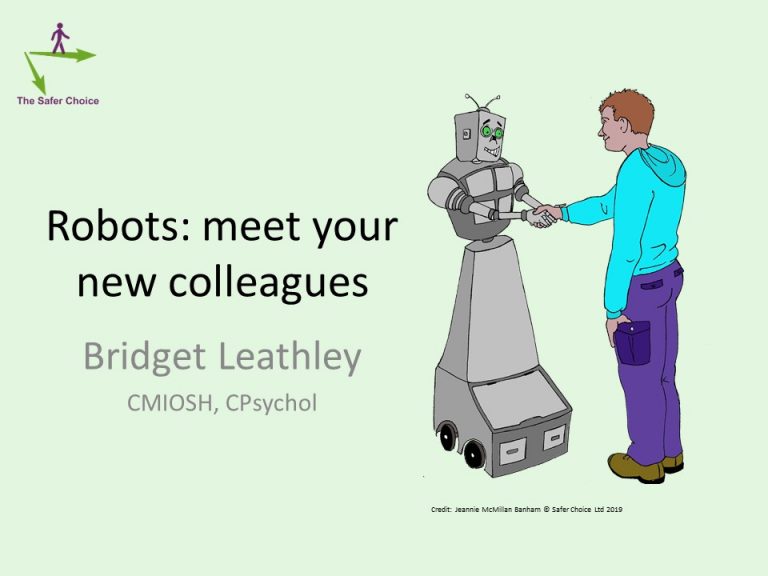
- Robots & cobots – meet your new colleagues. Some of the opportunities – and challenges – of working alongside robots.
- Robots at Amazon UK. An account of a visit to the Amazon warehouse in Tilbury, where robots work alongside pickers and packers.
- Safety net. A look at the advantages and challenges of the Internet of Things, with examples of how UAVs (drones), wearables, hearables and geographic positioning could enhance health and safety in the workplace.
- Tech top to toe. Looking at the benefits and barriers to using wearable technology in personal protective equipment (PPE) and other safety and health applications. I devised a workshop for the annual IOSH Conference in 2017 to bring together providers of wearable tech and OSH practitioners to invent new wearable solutions. Ideas included safety boots that warn you when they need replacing, and a lab coat that detects hazardous. If you’d like to know more about this, get in touch.
One of my early, peer-reviewed papers on Human–computer interaction in safety-critical systems looks at how menu structures in the user interface impact choices made by operators.
I was asked to write this article about software to manage environmental control actions on the IEMA website.
I am often asked for comments on how technology can support safety and health management. See my contribution to Is EHS software the Holy Grail? in IOSH Magazine (quick answer: no), a panel discussion on digital technology hosted by HSW Magazine, and my predictions for 2023 in IOSH Magazine.
What is... what we think we understand about terms used in health and safety
The What is.. series was originally published in Health and Safety at Work Magazine (which is no longer available). The aim was to challenge received wisdom on the meaning of terms we use in health and safety. We use the terms inconsistently, haphazardly and without always thinking through the implication of their use. In many cases my ideas have moved on since I wrote these articles, but the challenges presented by each article are just as relevant now as when they were written.
- What is a hazard?
- What is foreseeability?
- What is a control?
- What is reasonably practicable?
- What is significant?
- What is suitable and sufficient?
- What is competence?
- What is a near miss?
I’ve written other articles that while not part of the original What is.. series, have a similar approach. These cover:
- Human error, looking at the problem of blame, error proneness and the benefits of human variability
- In An Uncertain Ratio, I look at Heinrich’s accident triangle and its variations. While some people want to dump the whole model, I consider if it still has some value in modern healthy and safety practice. I was delighted to find this article referred to in an NHS report on health, safety and wellbeing.
- The price of a life – it turns out you can put a price on safety.
- Everything in proportion. How ALARP and practicability apply in financial terms.
What do we really mean when we say ‘behavioural safety’? An article for RoSPA where I argue that we need to stop blaming workers for poor behaviour, and instead embrace human factors and design systems that inherently promote safe behaviour.
Evidence for.. a review of the evidence for and against received wisdom in health and safety
- Sit-stand desks: are they worth the extra cost?
- Ergonomic interventions for display screen equipment: which ones are worth it – and which are just gimmicks?
- Financial incentives: can we bribe people to be safer and healthier? (Updated June 2021)
- Manual handling training: why manual handling training might not be the most effective way to reduce manual handling injuries
- Pain factory: it’s more than physical ergonomics looks at why we need to look beyond purely mechanical explanations for pain in musculoskeletal disorders
- E-cigarettes the smoke screen around the ‘95% less harmful’ figure, and what you should consider in your workplace smoking/ vaping policy.
- Hearing protection: why noise controls aren’t working
- Generations: what young workers really need, and why we should stop talking about ‘Gen Z.’
- Older workers: an asset or a liability?
- Health promotion in the workplace: can employers have any impact of employee health and wellbeing?
- Smoking, alcohol and drugs: should employers have a role in managing people’s bad habits outside work?
- Workplace stress programmes: how should employers spend their resources to reduce stress-related absences?
- In-car safety systems: what’s available, and how can employers make best use of it for fleet drivers?
- HGV: how can heavy goods vehicles be safer for cyclists and pedestrians?
Learning from.. what can OSH professionals can learn from other professions?
This series was published in IOSH Magazine, so these links will take you to the IOSH Magazine website:
- Quality managers know that quality has to be part of the process, not an ‘add-on’. How can this idea help us to build safety in?
- Software developers have made great strides in the past decades. Gone are the thick manuals we had to read to use an application on a computer. So why are we still asking people to read safety manuals and procedures?
- Behavioural economists know that you get more from people by nudging than nagging. How can we use the same principles in health and safety?
- Safety critical assurance involves detailed analysis of systems to prevent fatal and wide-spread errors. In occupational health and safety it’s not reasonably practicable to apply the same techniques, but can we adapt some of their tools and techniques? Read how SWIFT (structured what if technique) could improve your risk assessments.
- Health psychologists have developed tools to pick and choose the best ways of supporting behaviour change – so why do health and safety professionals resort to ‘it seemed like a good idea at the time’ approaches?
- Cognitive psychologists can warn us of the mistakes how minds can trick us into during accident and incident investigation, and how to overcome unconscious bias.
- Lean Sigma Six black belts have lots to teach us about how to improve safety without increasing bureaucracy.
- Expert Witnesses get to look at the evidence when it goes wrong, so they know a thing or two about what we should be doing to prevent accidents, and where they happen, to provide a defence.
- Magicians are perhaps the least likely profession we might turn to for lessons. However, both magic and accidents make use of the same cognitive loopholes in how we see and think.
Although not part of the above series, these articles also illustrate how to learn from other areas:
- K is for Kanban as part of the Lexicon series.
- AGFA case study following a visit arranged by Onsite Insights.
Health and safety in practice
- Why climate change should be part of your OSH risk assessments (RoSPA) An article for RoSPA looking at some impacts of climate change on the weather, air pollution and biological hazards, and what we should be doing to mitigate the impacts.
- Risk assessment: Pitfalls and how to avoid them (RoSPA). Drawing from HSE research, plus ten years of research for my book, I outline the most common pitfalls and how to avoid them in just 1500 words.
- Understanding the Hierarchy of Control: Practical applications across industries (RoSPA). Covered in more detail in Chapter 11.
- Taken to task (IOSH Magazine) explains how task analysis should be as much of a tool for OSH professionals as is risk assessment.
- Reality check (IOSH Magazine) considers the role of audits in effective health and safety management systems, with views from those who use – and don’t use – audits. If you want a more recent scientific view, read this paper (not mine!) in Safety Science.
- Not my article, but I was asked for my advice on preparing for crisis management.
- Shaken and stirred (IOSH Magazine) in which I attempted to referee the debate between providers of hand-arm vibration measurement tools and experts.
- Contractor management: prequalified successes. The first of two articles on managing contractors safely, focussing on selecting contractors.
- Contractor management: agents in place. The second article, focussing on what to do once the contractors have been selected.
- A term for the worst. Although based on cases up to 2015, this article on health and safety practitioner liability still has lessons for professionals on not overreaching their competence.
- Adapting health and safety management for remote and hybrid workers. A post-pandemic article with some ideas on protecting mobile, remote and hybrid workers.
Lexicon series
Facilities and building safety
I provide training in various facilities management topics, including legionella, asbestos, contractor management, fire safety management and hazardous substance assessment. These three articles for RoSPA provide an overview of some of these topics.
- Facilities management: the basics
- Legionella and water management
- Facilities management basics: grounds management
Here are some earlier blogs I’ve written for others:
- Asbestos: How to Improve Your Checks. Bringing your asbestos condition checks in-house could improve management and save you money.
- 4 Reasons to review your hazardous substance (COSHH) assessments. Explains why we need to review our approach to the management of risk from hazardous substances.
Stories
Kate’s learning journey – how Kate moved from pointless learning how to move boxes to reducing manual handling risk.
Blogs & white papers
Blogs on health and safety topics
I have written lots of blogs for engage EHS (previously known as Effective Software, and now part of the EcoOnline group) and for eLearning company, Essential Skillz. Most of these are ghost written – so you’ll find someone else’s name given as author! I’ve listed only a few here – all links will take you to another website:
- Why safety audits fail. The need to act on lessons learned, and how technology can help.
- 5 reasons audits fail, and what to do about it. TLDR: lack of resources, competence and independence, auditing to assure and auditing work as imagined.
- How to increase near miss reporting on factory floors. I apply the EAST framework developed by the UK Behavioural Insights Team to the problem of near miss reporting.
Blogs on ergonomics
These articles were all written for Nexstand EU. While obviously I was paid to say nice things about them, I genuinely like the laptop stand they sell, and it has replaced the one I used to use. These blogs also illustrate how I can tie useful information into a blog about your product.
- Essential ergonomics during the COVID-19 threat. Much has been written about the problems of homeworkers during the pandemic – but what about those returning to work? How do you hot-desk, safely, during a pandemic?
- Zooming to meet you. Tips on setting up your laptop for Zoom calls, so that you look and feel good.
- Display Screen Equipment for teenagers. Even before lockdown, children and teenagers were suffering from upper body pains, rare in this age group in previous generations. But there are things you can do to help protect your teens, and younger children.
- 4 Top Tips to be a successful digital nomad. Bit of a flight of fantasy here – written in the depth of lockdown, I imagine what it would be like to travel the world and work at the same time.
White papers
These whitepapers have all been produced for organisations which produce technology to make safety and health management more effective. I only write for organisations with a produce I believe in, so if you want me to write for you, be prepared to give me a demo of your product first. The links will take you to the vendor websites:
- The role of AI in promoting a proactive safety culture. With my own visualisation of safety culture, a primer on AI, and examples of how AI provides scaffolding for culture change.
- ISO 45001: Benefits and pitfalls to accreditation. An ISO standard might be more than you need, it might even have a downside, but read this if you’re thinking of going for accreditation to ISO 45001 or a similar standard.
- The future of ISO 45001. Is an international standard for occupational health and safety management a sensible thing to develop? How can a format intended to control the size of screws support something as complex as the way we work? (No longer available online, but contact me if you’d like a copy).
- Growing safety engagement in your workplace. There’s a lot of talk about ’employee engagement’ in health and safety. But what do we mean by ‘engagement’ and how can you encourage it?
- Near miss reporting: equipping yourself for the unplanned. Provides a good introduction to the topic of near misses (and other synonyms) for non-specialists, and challenges some of the current approaches to the topic. (No longer available online due to a change in the product it supports, but contact me if you’d like a copy).
- Getting senior management buy-in for safety software. Describes how to influence and persuade C-suite managers to support your safety projects.
- Crisis management: how improving our understanding of the way we think, before, during and after a crisis, can lead to better decision-making.
- Writing about the use of AI in occupational health and safety in two papers – AI’s role in promoting a proactive safety culture and Getting Senior Buy-In for your AI safety Software Project.
Prefer to watch or listen?
Short video clips
These video clips were recorded as part of a longer podcast (audio only) on writing effective safety procedures.
- What do safety procedures and recipes have in common?
- Can health and safety professionals write good procedures on their own?
- How do you test the language level in your procedures?
- Are flowcharts a better way to present instructions?
- When should you use video in procedures?
- How often should you review your procedures?
- Why do you need to practise procedures more often?
Here’s a short video explaining how AI-driven computer vision could improve reporting by staff.
Webinars requiring registration
Some webinars require registration:
- How to engage senior management in your safety software project. July 2021, with IOSH Magazine.
- A variant of How to engage senior management in your safety software project, October 2021, for HSM.
- Growing safety engagement in your workplace. September 2021, with the South and West Wales Safety Group.
- Are your business and workforce ready to manage a crisis? March 2022, with Kjell Brataas.
- Rethinking workforce OSH training and learning. April 2022, with IOSH Magazine.
- AI v the EHS manager, September 2022, discussing with James Carter of Marks & Spencer how Computer Vision AI can be used to support coaching conversations with ProtexAI.
- AI’s role in promoting a proactive safety culture, June 2023 with Protex AI
- Safety leadership lessons of Shakespeare’s works, April 2024. An ‘out side the box’ event where we see what Shakespeare thought about safety management and leadership (and we look at the risk assessment in Henry IV). With Louis Wustemann and Ideagen.
Webinars without registration
You can listen to (and sometimes watch) me in some webinars below, or visit The Safer Choice YouTube account.
Example videos (no registration needed):
The Future of Work - challenges and opportunities, April 2024
Following a panel session at the Safety and Health event at the NEC, I took part in a videod podcast with James Pomeroy, discussing the challenges of the future of work. Hosted by IOSH Magazine.
Effective safety procedures, June 2022
Sometimes, amidst all the talk of culture, behaviour and technology, it’s about having the right procedures, delivered in a way that they can be understood. A long conversation with Mary Conquest, but you can dip into parts of it as it’s well indexed.
Securing leadership buy-in for your safety initiative, April 2022
As part of a panel, I explain three steps for getting support from senior leaders for health and safety initiatives. Hosted by Safeopedia for a largely US audience.
Can technology help drive behaviour change? November 2020
I explain the hierarchy of behaviour change, as part of a panel on how technology is being used to support safety behaviours.
Presentations
A few examples of presentations I’ve given to professional audiences. For more examples see my Presentations page. If you’d like a presentation on these or other topics I’ve covered in articles, please get in touch.
Virtual classrooms for safety training
Online presentation to IOSH Thames Valley on 7 October 2020.
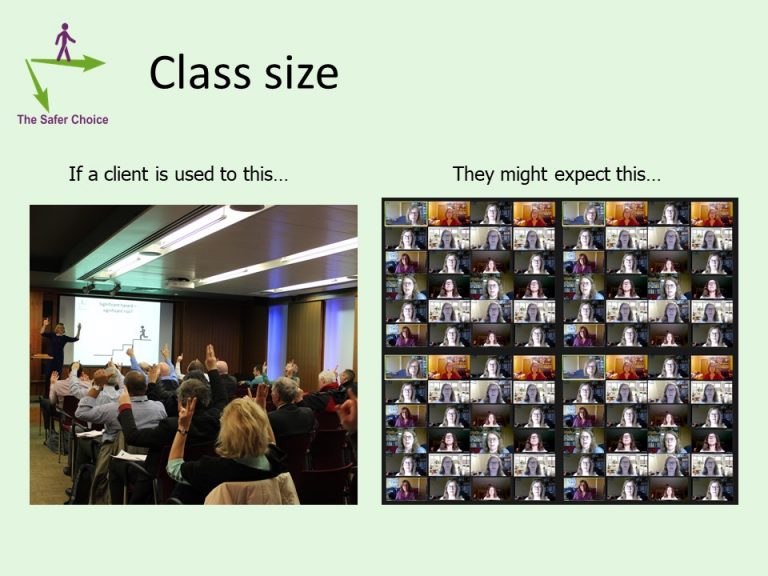
Robots for healthy workplaces
Health and Wellbeing Event, March 2020
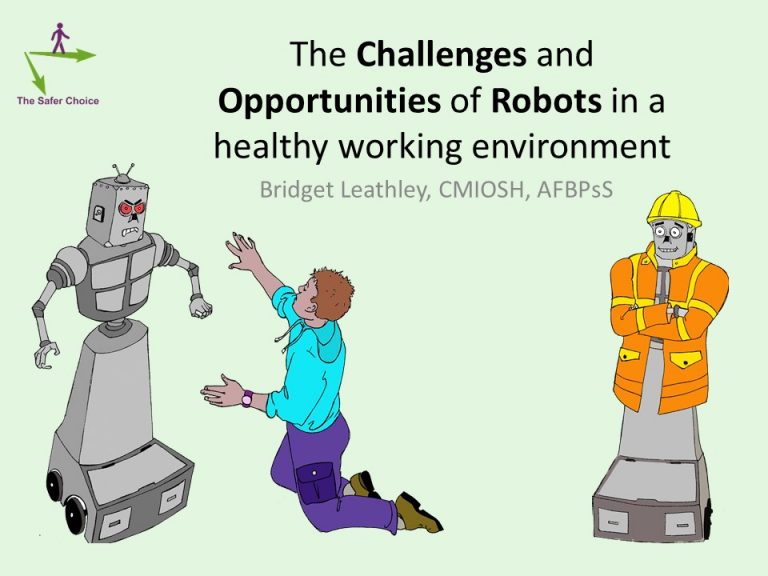
Robots for future leaders
IOSH Future Leaders event, November 2019